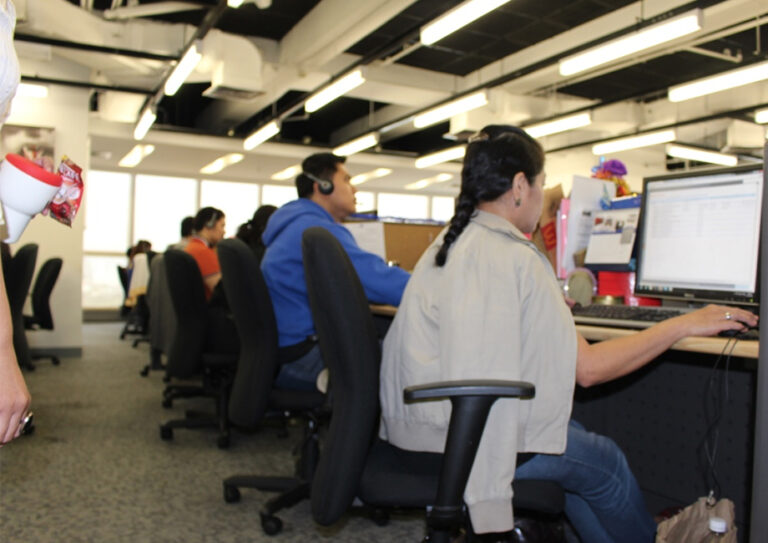

Every support conversation hands an agent something worth stealing: a card number, a date of birth, an account history or a medical detail. Data security in contact center customer support is the discipline of making sure that information is seen only by the person who needs it, for only as long as the task requires, and leaves a record every time it is touched. When the agents sit in the Philippines, the same standard applies, and our guide to compliance and data protection for offshore delivery sets out how buyers verify it before a contract is signed. This article covers the working controls: what a vendor must run on the floor, in its systems and in its contracts.
Where a support operation exposes personal information
Most exposure happens in ordinary work, not in dramatic hacks. An agent verifying identity reads out personal details, a chat transcript captures a card number the customer typed without being asked, a screen recording stores a full account page, and a supervisor exports a quality sample to a spreadsheet. Each of those is a copy of customer data that now lives somewhere new.
Mapping those copies is the first job. A useful exercise is to follow one interaction from the moment it enters the queue to the moment its records are deleted, and list every system, person and file that holds a piece of it along the way. The usual places sensitive information collects are:
- Call recordings and screen captures kept for quality assurance and dispute handling.
- Chat, email and ticket histories in the CRM, including attachments customers upload.
- Reports and exports pulled by team leads, analysts and workforce planners.
- Knowledge-base articles and training material that quietly include real customer examples.
- Agent desktops, browsers and any local storage that has not been locked down.
Once the map exists, most controls follow naturally: remove what is not needed, mask what must be handled, and log what remains.
Technical controls a vendor should already run
A credible provider can show you its controls working, not just describe them. Ask a Philippine provider for a walkthrough of a live workstation and the admin consoles behind it rather than a slide deck.
Encryption in transit and at rest
Voice, chat and CRM traffic should travel over encrypted connections end to end, including the links between the vendor’s site in Manila or Cebu and your platforms in the US. Recordings, backups and databases should be encrypted at rest, with keys managed so that the vendor’s own administrators cannot casually read stored content.
Least-privilege access and strong authentication
Role-based access means an agent on a billing queue sees billing fields and nothing else. Multi-factor authentication on every system, named accounts rather than shared logins, and same-day removal of access when someone moves team or leaves are the baseline. Quarterly access reviews, signed off by both the vendor and the client, catch the permissions that drift in between.
Payment and identity masking
The safest card number is one the agent never hears. Secure payment capture tools let customers key digits on their phone while the agent stays on the line, and recording systems pause automatically during those moments. The same idea applies to government ID numbers and health identifiers: tokenize or mask them so that most staff never see the full value.
Locked-down endpoints and monitoring
Production workstations should block USB storage, personal email, printing and screen capture, and run through virtual desktops so that data stays in the client environment. Security monitoring should collect logs from every system that touches customer records and alert on unusual behavior, such as an agent opening far more accounts than their queue explains.
People, training and a culture that reports problems
Most incidents start with a person, so the people controls matter as much as the technical ones. Background checks at hiring, confidentiality agreements, and a clean-desk policy that keeps phones and paper off the production floor are standard in well-run delivery centers across the Philippines.
Training should be specific to the account, not a generic annual video. Agents need to recognize social engineering aimed at them, such as callers who pose as customers to reset credentials, and phishing that targets the vendor’s own staff. Short refreshers after every real incident or near miss work better than one long course a year.
Culture is the part buyers most often skip in due diligence. A floor where agents feel safe reporting a mistake, such as reading a card number aloud or sending an email to the wrong customer, surfaces problems in minutes. A floor where mistakes are punished hides them until an audit or a complaint finds them. Ask the vendor how many incidents agents self-reported last quarter; a thoughtful answer tells you more than a claim of zero.
The legal frame on both sides of the Pacific
Your obligations travel with your data, and the vendor adds a second legal layer rather than replacing the first. US rules such as HIPAA for health information and state privacy laws, along with card-industry standards such as PCI DSS, still apply when the work is done in the Philippines, and your contract with the provider is how you pass those duties down.
On the vendor’s side, the Data Privacy Act of 2012 (Republic Act No. 10173) governs how personal information is processed in the Philippines and is administered by the National Privacy Commission. The law makes a controller that subcontracts processing responsible for ensuring proper safeguards are in place, requires prompt notice to the Commission and affected people when sensitive personal information is breached, and carries prison terms and fines for unauthorized processing. For a US brand, that means a Filipino provider already works under a national privacy regime with an active regulator, which strengthens rather than substitutes for your own contractual controls.
Programs that span several jurisdictions add complexity quickly; our piece on navigating regulatory requirements across multiple jurisdictions explains how to keep one control framework from splintering into many.
Audits, certifications and testing
Certifications prove a control framework exists; testing proves it works on your account. You need both. Independent attestations such as SOC 2 Type II and ISO 27001 show that an auditor examined the vendor’s controls over a period of time, and PCI DSS and HITRUST cover card and health data specifically. These are the standards PITON-Global lists on its capabilities page as the governance frame for its vetted delivery hubs.
Certificates have limits. They usually cover a site or a service scope, so confirm that the scope includes the building and platforms your team will use. Then add your own checks: a right-to-audit clause, annual penetration testing by an external firm, and a review of the vendor’s last incident report and how it was closed. The forensic diligence and security audit step in our vetting framework is where these questions are asked before a shortlist is finalized.
Remote and hybrid agents without weaker controls
Remote work is allowed, and it can be secure, but only if the home setup mirrors the floor. The CREATE MORE Act, signed in November 2024, lets registered business enterprises run work-from-home arrangements for up to half their workforce without losing incentives, as the Daily Tribune reported. Many Philippine vendors now run hybrid teams as a result.
For accounts that handle sensitive data, a remote seat should use a company-issued, centrally managed device, a virtual desktop with no local storage, multi-factor login, and a private workspace policy the vendor actually checks. Some buyers keep payment and health queues on-site only and allow remote work for lower-risk tasks such as order status. That split is a reasonable default until the vendor has shown clean audit results for its remote seats.
Remote capacity also doubles as resilience. When a storm or outage closes a site, agents who can log in securely from home keep queues moving, a point finance teams weigh when they assess economic and operational risk in an offshore program.
Incident response: the plan you hope not to use
A breach is judged as much by the response as by the cause. Your contract should set how quickly the vendor must tell you about a suspected incident, who leads the investigation, who notifies customers and regulators, and who pays for remediation.
Rehearse it. A tabletop exercise once a year, run jointly across US and Philippine time zones, with the vendor’s security lead and your own, will expose gaps in contact lists, logging and decision rights long before a real event does. Customer-facing communication belongs in the same plan, because a data incident often becomes a public trust problem within hours.
A buyer’s checklist before go-live
Before the first live interaction, confirm each of the following in writing:
- A data-flow map of the account, signed off by both security teams.
- Current certificates whose scope covers your site and platforms, plus the latest audit report.
- Role-based access lists, multi-factor authentication and a same-day de-provisioning process.
- Payment and identity masking in place, with recording pauses tested.
- Account-specific security training completed by every agent and team lead.
- An incident response plan with named contacts, notice times and a date for the first tabletop exercise.
- Contract clauses for audit rights, data return and deletion at exit, and liability for breaches.
Frequently asked questions
Is customer data safer onshore than with an offshore vendor?
Location matters less than controls. A certified site in the Philippines with locked-down desktops, masking and active monitoring can be safer than a loosely managed domestic one. What changes offshore is the need for clear contract terms and regular independent evidence.
Does the Philippine privacy law replace my US obligations?
No. Republic Act No. 10173 governs the vendor’s processing in the Philippines, while HIPAA, PCI DSS and state privacy laws continue to apply to you. Your contract should require the provider to meet both.
Which certification matters most?
It depends on the data. SOC 2 Type II or ISO 27001 is a sensible baseline for any account; PCI DSS is essential if agents take payments, and HITRUST or documented HIPAA controls are expected for health information.
How often should a vendor’s security be tested?
Review access quarterly, run external penetration testing at least annually and after major system changes, and hold an incident tabletop exercise once a year. Social media and crisis teams need the same rigor; our article on crisis response for brand communities covers the communications side.