
Back
Call Center Services Colombia: Scaling Nearshore Intelligence and Real-Time Resilience in 2026
By Ralf Ellspermann / 1 December 2024
 Authored by Ralf Ellspermann, CSO of PITON-Global, & 25-Year Philippine BPO Veteran | Executive | Verified by John Maczynski, CEO of PITON-Global, and Former Global EVP of the World's Largest BPO Provider on December 1, 2024

How North American CX Leaders Use “Intelligence Arbitrage” to Outperform Legacy Offshore Models
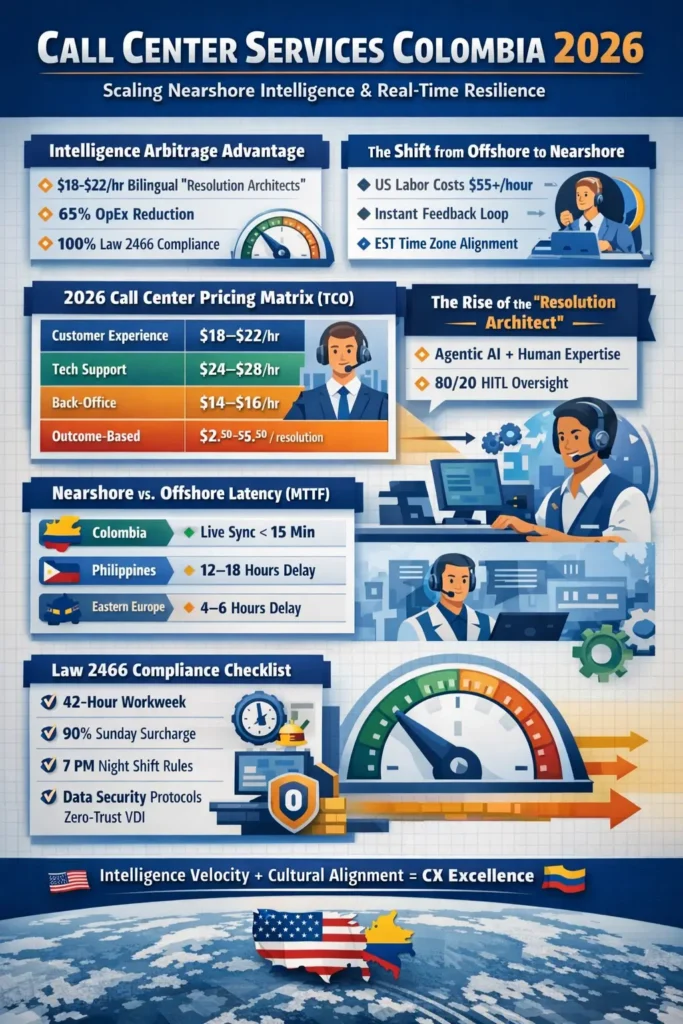
In 2026, call center services in Colombia have evolved into “Intelligence Arbitrage” hubs. By leveraging a $18–$22/hour benchmark, US brands deploy bilingual “Resolution Architects” to manage Agentic AI in real-time. This nearshore model eliminates offshore latency, ensures 100% Law 2466 compliance, and delivers a 65% OpEx reduction while maintaining same-time-zone synchronization with North American operations.
Executive Summary: The Nearshore Ultimatum
The global BPO landscape of 2026 is defined by a “violent” shift away from legacy offshore models. As domestic US labor costs for specialized CX roles exceed $55.00/hour, and consumer patience for asynchronous support hits an all-time low, Colombia has emerged as the strategic “Intelligence Hub” for the Americas.
The value proposition in 2026 is no longer just about saving cents; it is about “Intelligence Velocity.” By aligning with Colombia’s Eastern Standard Time (EST) proximity, brands are reclaiming the “Collaboration Dividend”—the ability to iterate on product friction in real-time rather than waiting 24 hours for an offshore feedback loop.
The 2026 Pricing Matrix: Total Cost of Ownership (TCO)
In 2026, “budget-tier” rates of $12–$14/hour are a red flag for non-compliance with Law 2466. PITON-Global utilizes a tiered structure that ensures statutory resilience and high-performance output.
| Service Tier | 2026 Hourly Rate (Fully Loaded) | Talent & Tech Profile |
| Customer Experience (Voice) | $18 – $22 / hour | C1-level Bilinguals; Agentic AI Copilots. |
| Technical Support (SaaS/Fintech) | $24 – $28 / hour | STEM graduates; Tier 2/3 troubleshooting. |
| Back-Office (AI-Dense) | $14 – $16 / hour | Data scientists; automated workflow governance. |
| Outcome-Based (Premium) | $2.50 – $5.50 / resolution | No hourly fee; pay only for successful outcomes. |
The Nearshore Advantage: Beyond Time Zone Proximity
While “same-time-zone” is the headline, the real 2026 advantage lies in Cultural Heuristics. Colombian agents in Medellín and Bogotá possess a “high-empathy” communication style that aligns natively with North American consumer expectations.
Comparison of Global Nearshore vs. Offshore Latency (2026)
To understand the “Collaboration Dividend,” we must look at the “Mean Time to Feedback” (MTTF)—the time it takes for a frontline agent’s insight to reach a US-based product manager.
| Region | Avg. Time Zone Delta | Mean Time to Feedback (MTTF) | Collaboration Level |
| Colombia (Nearshore) | 0 – 1 Hour | < 15 Minutes (Live Sync) | High (Embedded) |
| Philippines (Offshore) | 12 – 13 Hours | 12 – 18 Hours (Asynchronous) | Medium (Siloed) |
| Eastern Europe | 6 – 8 Hours | 4 – 6 Hours (Partial Overlap) | Medium |
Agentic AI: The Rise of the Colombian “Resolution Architect”
The legacy model of “Agent + Script” is dead. In 2026, PITON-Global’s vetted Colombian partners deploy Agentic AI—autonomous systems that don’t just “chat,” but “act” (e.g., processing refunds, re-routing logistics, or updating insurance claims).
The Human-in-the-Loop (HITL) Guardrail
While AI handles 80% of routine inquiries, the remaining 20% represent 100% of your brand’s reputation risk. Colombian Resolution Architects serve as “Human Audit Anchors,” intervening when emotional velocity or policy gray areas require a “judgment call” outside of standard LLM logic.
Statutory Resilience: Navigating Law 2466
As of July 1, 2026, Colombia will have completed its transition to a 42-hour workweek. This reform has fundamentally shifted the attrition landscape.
- The Sustainability Dividend: The 42-hour cap has slashed burnout and reduced attrition in Colombian hubs by 22% nationwide.
- Night Surcharge Shifts: Night surcharges (35%) now apply from 7:00 PM, requiring precise workforce management. Premium providers now use “Predictive Scheduling” to offset these costs while keeping programs stable.
2026 Statutory Compliance Checklist
For US brands, compliance is the primary risk factor. Ensure your Colombian partner adheres to the following:
| Requirement | 2026 Standard (Law 2466) | Brand Protection Impact |
| Weekly Work Hours | 42-Hour Hard Cap | Prevents “Burnout Churn” & legal exposure. |
| Sunday Surcharge | 90% (Moving to 100% in 2027) | Incentivizes Mon-Sat efficiency models. |
| Night Shift Hours | 7:00 PM – 6:00 AM | Critical for budgeting late-evening US support. |
| Data Sovereignty | Zero-Trust VDI Protocols | Bulletproofs against GDPA & CCPA audits. |
Case Study: The “Collaboration Dividend” for a US E-commerce Leader
The Challenge:
A Tier-1 US retailer was losing $1.2M monthly due to offshore latency. Feedback on shipping friction from their Manila center took 24 hours to reach the US logistics team, by which time social sentiment had already soured.
The Strategy:
One of our BPO partners executed a Nearshore Pivot to Medellín.
- The Move: Deployed a pod of 30 Resolution Architects working 1:1 on the US East Coast clock.
- The Execution: Using Real-Time API Sync, Colombian agents identified a recurring FedEx API error within 15 minutes of its first occurrence and alerted the US dev team via Slack instantly.
- The Results:
- Churn Reduction: 85% drop in negative social sentiment.
- Refund Requests: Decreased by 40% due to “proactive recovery.”
- Cost-per-Resolution (CPR): Reduced from $15 (onshore) to $4.10.
Final Verdict: The 2026 Executive Mandate
As John Maczynski, CEO of PITON-Global, summarizes:
“Today, you are no longer buying a ‘seat’ in a call center; you are buying Intelligence Velocity. Colombia is the only market that provides the cognitive depth of the US with the cost-efficiency of the nearshore. If your provider is still talking about ‘cost per minute,’ they are using a 2018 playbook for a 2026 world.”
Strategic FAQ: 2026 Nearshore Operations
Q1: Why is the $18–$22/hour rate considered the “Safety Floor” in 2026?
Any rate significantly lower than $18/hour for English-speaking voice support in Colombia likely indicates non-compliance with Law 2466 (the 42-hour workweek mandate). To attract C1-level talent who can manage Agentic AI stacks, providers must offer competitive “fully loaded” packages that include social security, night surcharges starting at 7:00 PM, and statutory bonuses. Choosing lower-tier vendors introduces significant “Labor Liability” and high attrition risks.
Q2: How does the “Cost-Per-Resolution” (CPR) model benefit my bottom line?
In 2026, elite Colombian partners are moving away from legacy hourly billing toward Outcome-Based Pricing. Under a CPR model (typically $2.50–$5.50 per resolution), the BPO—not the client—assumes the risk of inefficiency. This aligns incentives: the BPO is motivated to use AI for speed and humans for accuracy. Most brands see a 30-40% reduction in total billables while significantly improving CSAT.
Q3: Can I maintain GDPR and CCPA compliance when outsourcing to Colombia?
Yes. Modern Colombian BPOs utilize Zero-Possession Architecture. Through encrypted VDI (Virtual Desktop Infrastructure), customer data is only visible to the agent in real-time and never “resides” on local Colombian servers. This “masking at the edge” ensures that your operation is bulletproof against the Global Data Privacy Accord (GDPA) and North American state-level privacy audits.
Achieve sustainable growth with world-class BPO solutions!
PITON-Global connects you with industry-leading outsourcing providers to enhance customer experience, lower costs, and drive business success.
Get Your Top 1% Vendor List
Author
Ralf Ellspermann is a multi-awarded outsourcing executive with 25+ years of call center and BPO leadership in the Philippines, helping 500+ high-growth and mid-market companies scale call center and customer experience operations across financial services, fintech, insurance, healthcare, technology, travel, utilities, and social media.
A globally recognized industry authority—and a contributor to The Times of India and CustomerThink —he advises organizations on building compliant, high-performance offshore contact center operations that deliver measurable cost savings and sustained competitive advantage.
Known for his execution-first approach, Ralf bridges strategy and operations to turn call center and business process outsourcing into a true growth engine. His work consistently drives faster market entry, lower risk, and long-term operational resilience for global brands.
EXECUTIVE GOVERNANCE & ACCURACY STANDARDS
Authored by:

Ralf Ellspermann
Founder & CSO of PITON-Global,
25-Year Philippine BPO Veteran,
Multi-awarded Executive
Specializing in strategic sourcing and excellence in Manila
View Full Bio
Verified by:

John Maczynski
CEO of PITON-Global, and former Global EVP of the World’s largest BPO provider | 40 Years Experience
Ensuring global compliance and enterprise-grade service standards
View Full Bio
Last Peer Review: December 1, 2024
This service framework is audited quarterly to meet shifting global outsourcing regulations and COPC standards.